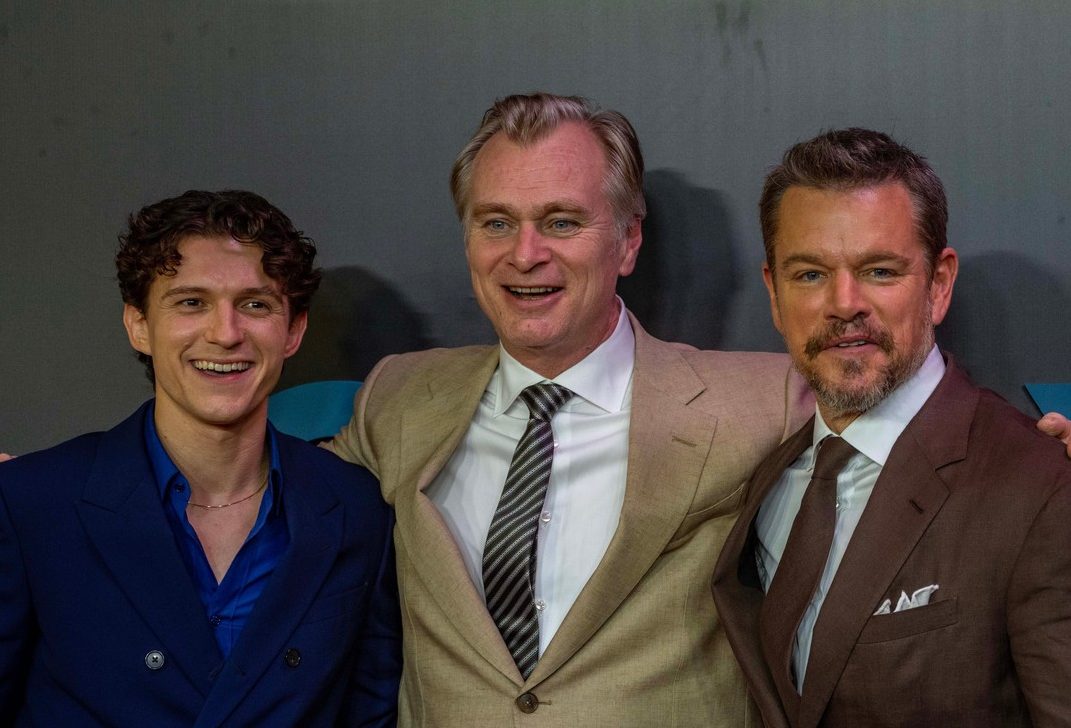
Today, as Christopher Nolan's "The Odyssey" opens in theaters worldwide, it arrives not as a gamble but as an event — projected by Variety and Deadline to earn $85–100 million domestically in its opening weekend, his biggest debut since "The Dark Knight Rises" in 2012, with reviews so strong (98% on Rotten Tomatoes at 147 reviews, per TheWrap — the highest score of his career) that awards talk began before the public had seen a single frame. It is worth pausing on how improbable this is. A three-thousand-year-old Greek poem, adapted with no franchise, no superhero, and a $250 million budget, is the biggest bet of Hollywood's summer — sold almost entirely on one man's name. Very few directors in the history of cinema have commanded that kind of trust. This is the story of how Nolan earned it: a career built over three decades on a simple, stubborn conviction that audiences are smarter than the industry believes, and that film — actual, physical film — is worth fighting for.
An Anglo-American Childhood and a Super 8 Camera
Christopher Edward Nolan was born in London on July 30, 1970, to an English father who worked in advertising and an American mother who worked as a flight attendant and teacher. The family split time between London and Chicago, and that dual Anglo-American identity would later define his filmmaking: British restraint and structural rigor married to the scale and ambition of the Hollywood blockbuster.
He began making films at age seven, borrowing his father's Super 8 camera to shoot short movies with his action figures. Two childhood experiences left permanent marks. The first was seeing "Star Wars" in 1977 and, more formatively, "2001: A Space Odyssey" during a 1977 re-release — his father took him to see it in London, and Kubrick's cosmic vision became a lifelong reference point that would surface decades later in "Interstellar." The second was a childhood spent partly in the era of the "video nasty" debates and analog cinema, which instilled a reverence for the theatrical experience.
Crucially, Nolan did not attend film school. He studied English literature at University College London — a choice he made in part because UCL had film equipment and a film society he could commandeer. There he met two people who would shape everything that followed: Emma Thomas, his future wife and producing partner on every single one of his films, and the university's 16mm equipment, on which he taught himself the craft. His literary education shows in his work; his films are structured like novels, obsessed with unreliable narrators, fractured chronology, and the mechanics of storytelling itself.
Following: A Feature Film for £3,000
Nolan spent his mid-twenties working corporate video jobs and script-reading while shooting his first feature on weekends over the course of roughly a year. "Following" (1998), a 70-minute black-and-white neo-noir about a writer who shadows strangers through London, was made for around £3,000 — about $6,000 — with a cast and crew who kept their day jobs. Because film stock was precious, scenes were rehearsed exhaustively so most could be captured in one or two takes.
Even at this micro-budget scale, the Nolan signature was fully formed: the story is told out of chronological order, forcing the audience to assemble the puzzle. "Following" played festivals, won awards at Slamdance and San Francisco, and did something more important — it proved to financiers that Nolan could deliver a coherent, gripping film with essentially no money.
Memento: The Breakthrough Told Backwards
His brother Jonathan Nolan — who would become his most important creative collaborator — pitched him a short story idea during a road trip: a man with anterograde amnesia hunting his wife's killer, unable to form new memories. Christopher's structural insight turned it into a phenomenon. "Memento" (2000) tells its story in two interleaved threads, one moving forward in black and white and one moving backwards in color, so that the audience experiences the protagonist's condition — never knowing what came before.
Made for about $4.5 million with Guy Pearce, the film was initially rejected by every major distributor, who considered it too confusing for audiences. Newmarket ultimately distributed it themselves in 2001. It grossed nearly $40 million worldwide, earned Oscar nominations for Best Original Screenplay and Best Editing, and became a cultural puzzle-box that people watched repeatedly just to decode. The lesson Nolan drew — that complexity is a commercial asset, not a liability — became the thesis of his entire career.
After the studio-assignment thriller "Insomnia" (2002), a remake starring Al Pacino and Robin Williams that proved he could handle stars and studio machinery, Warner Bros. handed him something far more valuable: a broken franchise.
Batman Begins and the Reinvention of the Blockbuster
By 2003, Batman was a punchline. "Batman & Robin" (1997) had killed the franchise with camp. Nolan's pitch was radical for its time: treat the character with total seriousness, ground him in a plausible world, and tell an origin story as a psychological drama. "Batman Begins" (2005), starring Christian Bale, grossed over $370 million worldwide and quietly changed the grammar of the modern blockbuster — the gritty, "realistic" superhero reboot became the industry's default template for the next two decades, for better and worse.
Between Batman films, Nolan made "The Prestige" (2006), a tale of rival Victorian magicians starring Bale and Hugh Jackman, itself structured like a magic trick with a devastating final reveal. It deepened his reputation as cinema's premier engineer of narrative machinery.
Then came "The Dark Knight" (2008). Anchored by Heath Ledger's posthumously Oscar-winning performance as the Joker, it became the first superhero film to gross $1 billion worldwide and forced a serious critical conversation about whether comic-book films could be genuine cinema. Its snub for a Best Picture nomination is widely credited with pushing the Academy to expand the category beyond five nominees the following year — a rare case of a single film changing the Oscars themselves. "The Dark Knight Rises" (2012) closed the trilogy with another billion-dollar gross and a $160 million opening weekend that, as Variety notes, remained his biggest debut for fourteen years — until this weekend, potentially.
Inception, Interstellar, Dunkirk: The Auteur Blockbuster
What Nolan did with the leverage from Batman is what separates him from nearly every other franchise director: he spent it on original ideas. "Inception" (2010) — a heist film set inside layered dreams, developed by Nolan over roughly a decade — had no source material, no stars in costumes, and a premise that required audiences to track four simultaneous timelines running at different speeds. It grossed over $825 million worldwide, won four Oscars, and its spinning-top ending became one of the most debated final shots in film history. Hollywood had insisted for years that original big-budget films were dead; "Inception" was the counterexample everyone had to reckon with.
"Interstellar" (2014) took the ambition cosmic — a relativity-driven space epic, made with physicist Kip Thorne as consultant, whose black hole visualizations were accurate enough to generate published scientific papers. It grossed over $700 million and has only grown in stature since, becoming for a younger generation what "2001" was for Nolan's.
"Dunkirk" (2017) was in some ways his most radical structural experiment disguised as a war film: three timelines — one week on land, one day at sea, one hour in the air — converging on a single event, with minimal dialogue. It earned Nolan his first Best Director nomination and grossed over $525 million, once again proving an "uncommercial" premise wrong.
Throughout this run, Nolan became cinema's most prominent evangelist for celluloid and large-format photography. He shoots on film, increasingly on IMAX cameras, refuses to use a second unit for major sequences, builds practical effects where the industry defaults to CGI, and famously does not use a smartphone or email in his creative process. When streaming threatened theatrical exhibition, Nolan became its loudest defender — publicly breaking with Warner Bros., his studio home of two decades, after it sent its entire 2021 slate to HBO Max simultaneously with theaters. "Tenet" (2020), his time-inverted espionage epic, had been the film asked to single-handedly revive theaters mid-pandemic; it grossed a respectable $365 million under impossible conditions, but the rift with Warner was final.
Oppenheimer: Vindication
Nolan took his next project to Universal, extracting conditions that only he could demand: a theatrical exclusivity window, a marketing commitment, and creative control. "Oppenheimer" (2023), a three-hour, R-rated biographical drama about the father of the atomic bomb, shot partly in black-and-white IMAX (a film stock Kodak had to manufacture for the first time at his request), should not have been a blockbuster by any conventional logic. Released opposite "Barbie," it instead became half of the "Barbenheimer" cultural phenomenon — opening to $82 million domestically and, as Variety reported, ultimately earning $330 million in North America and $975 million globally, the highest-grossing film ever made about a real person at the time.
At the 2024 Academy Awards, "Oppenheimer" won seven Oscars, including Best Picture, Best Director for Nolan, Best Actor for Cillian Murphy, and Best Supporting Actor for Robert Downey Jr. After eight nominations across his career, the Academy's long resistance to Nolan collapsed all at once. In 2024 he was also knighted, becoming Sir Christopher Nolan. The one label that had eluded him — Oscar-winning director — was finally his, and it changed the calculus for whatever he wanted to do next.
The Odyssey: Homer in IMAX
What he wanted, it turned out, was the oldest story in the Western canon. "The Odyssey," opening today, adapts Homer's epic of Odysseus' ten-year journey home from the Trojan War. Matt Damon plays Odysseus, Anne Hathaway is Penelope, Tom Holland is Telemachus, with Zendaya as Athena and an ensemble including Robert Pattinson, Charlize Theron, Lupita Nyong'o, Jon Bernthal, and — in a piece of casting Nolan explained as drawing a link between rap and oral poetry as kindred art forms — Travis Scott. Produced by Emma Thomas and Nolan through their company Syncopy for a reported $250 million, the film was shot on location across Italy, Iceland, Greece, Morocco, and Scotland, and it is the first feature shot entirely with new-generation IMAX film technology — bringing Homer to IMAX film screens for the first time.
The rollout has been an old-fashioned spectacle in itself: IMAX 70mm showtimes sold out a full year in advance, a world premiere in London on July 6 and a New York premiere on July 14, and Universal committing the film to an extended theatrical exclusivity window of at least five weekends — a direct reversal of the pandemic-era shrinking of theatrical windows, and a policy shift for which Nolan's advocacy deserves real credit. Reviews, per Forbes and TheWrap, are the best of his career, with some critics calling it his finest film. Tracking services cited by Deadline and Variety project an opening above $200 million worldwide.
What the Story Means
Step back from the individual films and a coherent arc emerges. A self-taught filmmaker with a literature degree and a £3,000 debut spent thirty years accumulating trust — from audiences, then from studios — and spent that trust, every time, on the same bet: that mass audiences will show up for demanding, original, formally ambitious work if you respect their intelligence and give them a reason to leave the house. He rescued the superhero film from camp, then walked away from superheroes at the peak of their profitability. He kept celluloid film stock in production almost single-handedly. He made theatrical exclusivity a negotiating point when the industry had given it up for dead.
Whether "The Odyssey" becomes his first non-Batman billion-dollar film — a question Deadline raises openly — matters less than what its existence already proves. In an era of algorithmic franchise management, the most bankable name in Hollywood belongs to a director whose brand is, essentially, difficulty done beautifully. Homer's epic begins with a plea to the muse to sing of a resourceful man who took the long way home. Nolan took the long way too — and the audience, as ever, followed.